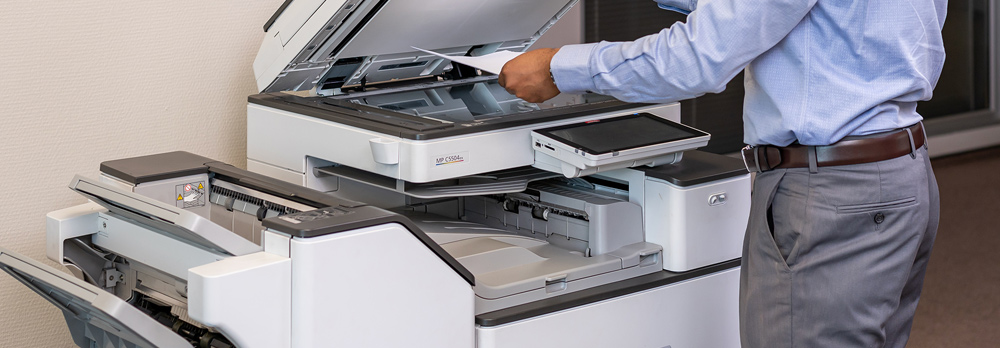
For smaller teams or home offices, a compact multifunction printer like the Nashua IM 2702 is often enough. It handles everyday tasks like printing, scanning, and copying without taking up too much space.
As your team grows, print volume usually increases as well. In this case, it makes sense to look at a printer that offers faster speeds, higher capacity, and more durability to keep up with daily use.
A few practical things to consider when choosing:
• Monthly print volume
• Print speed (pages per minute)
• Connectivity options such as Wi-Fi and mobile printing
• Running costs over time
Most small offices print anywhere between 500 and 5,000 pages per month, depending on their operations. It is worth noting that printing costs add up quickly over time. Even a difference of a few cents per page can make a noticeable impact on monthly expenses.
Printer with scanner and copier: do you need an all-in-one?
In most office environments, printing is not the only task. Documents are scanned, copied, and shared regularly, which is why all-in-one office printers are widely used. In many cases, this also includes scanning directly to email or cloud storage, which helps teams move documents faster without needing additional tools or manual steps.
An all-in-one printer makes sense if your business handles documents daily and needs a more streamlined setup. It reduces the need for multiple devices and keeps everything in one place. This kind of setup is especially useful in smaller offices where space is limited and efficiency is a priority.
In very low-usage environments, a single-function printer might still be enough. But for most businesses, having scanning and copying built in improves efficiency and saves time.
What should you consider before investing in an office printer in South Africa?
Before choosing between different office printers in South Africa, it helps to look beyond the upfront price and consider the full picture.
Total cost of ownership includes everything you will spend over time. This is often where businesses underestimate their spending, as ongoing costs like toner and maintenance can exceed the initial purchase price over the lifespan of the printer. In many cases, running costs can account for up to 70% of a printer’s total lifetime cost.
(Add a simple bar chart showing ~70% running costs vs ~30% purchase price)
Caption: Running costs (toner, maintenance) can account for up to 70% of total lifetime cost.
Print volume is another key factor. Choosing a printer that matches your usage prevents unnecessary costs, For example, using a low-volume printer in a high-demand environment can lead to frequent breakdowns and higher replacement costs.
Reliability matters because printer downtime can disrupt work. Businesses rely on consistent performance, especially in busy environments. This becomes even more important during peak periods such as month-end reporting, invoicing cycles, or high-volume admin tasks.
Service and support should also be considered. Access to local technicians and quick response times can make a significant difference when something needs attention. Delays in support can impact productivity, especially if printing is part of your daily operations.
Different types of printers also come with different running costs, so it is worth comparing how each option performs over time rather than focusing only on the initial price. Looking at long-term value rather than short-term savings usually leads to better decisions and fewer disruptions.
Buy, rent, or lease an office printer in South Africa?
There are a few ways to get an office printer in South Africa, and the right option depends on your budget and how your business prefers to manage expenses.
Buying a printer means you pay upfront and own the device. This option is often preferred by businesses that have the budget available and want full control over their equipment without ongoing commitments.
Renting offers more flexibility and is useful for short-term needs or temporary setups. It can also be a practical solution for events, project-based work, or businesses that are not ready to commit to a long-term investment.
Leasing allows you to pay monthly instead of making a large upfront investment. In many cases, maintenance and support are included. This reduces the risk of unexpected repair costs and makes it easier to plan monthly expenses.
Many businesses choose leasing because it spreads out printer costs and keeps cash flow predictable. For growing businesses, this can be a more manageable way to access reliable equipment without putting pressure on upfront capital.